A Linen Pinboard for the Kitchen Wall
Give the everyday paper a place to land with a simple linen-covered pinboard for the kitchen wall.
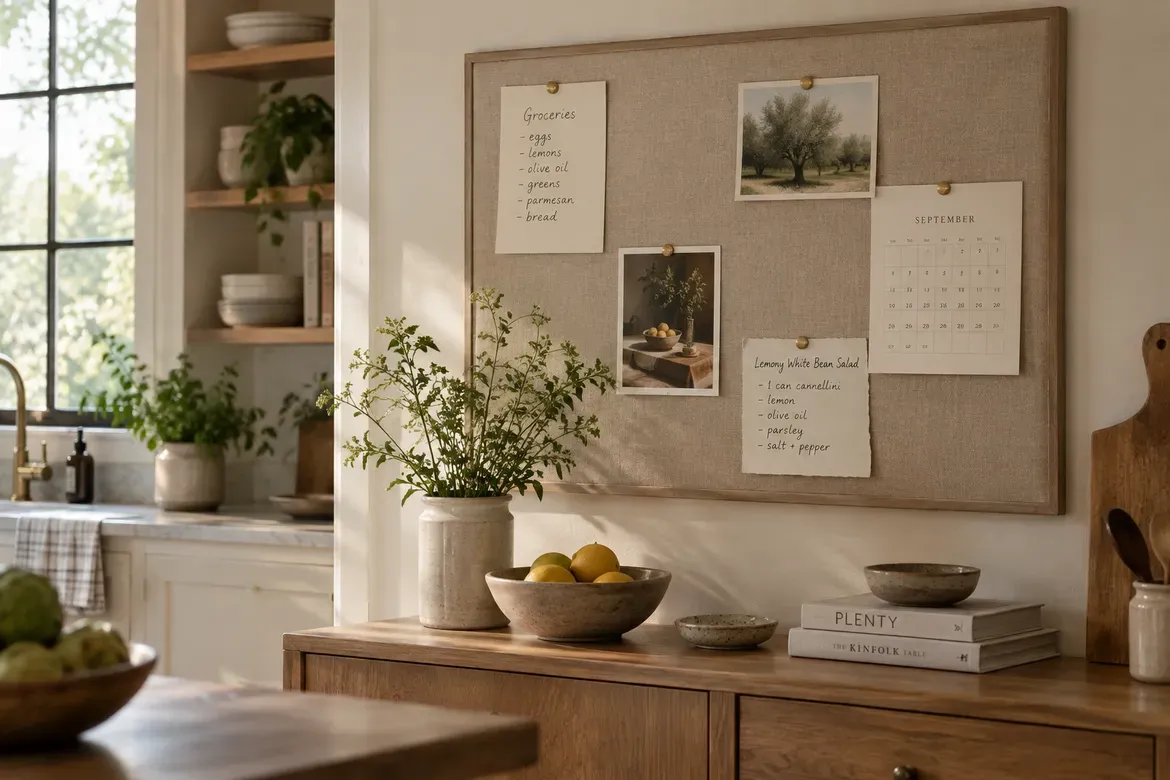
September has a way of bringing paper back into the house. School calendars, invitations, appointment cards, a recipe torn from a magazine, the receipt you actually need to keep. Left alone, all of it drifts toward the kitchen counter.
A pinboard is an old-fashioned solution in the best sense. Covered in linen instead of bare cork, it feels less like office equipment and more like part of the room.
Start with enough room
A tiny board fills up almost immediately and begins to look frantic. Something around 24 by 36 inches is more useful for most kitchens: large enough for the week to spread out a little, but still easy to fit on a narrow wall.
Look for a simple unframed cork board with a firm backing. The backing matters more than the cork itself because it gives the staples something solid to hold.
For the fabric, choose medium-weight linen or cotton with a visible weave. Oatmeal, flax, warm gray, or a muted stripe all work well. Very loose linen can stretch out of shape as you pull it around the board.
What you need
- An unframed cork board
- Enough linen or cotton to extend 3 to 4 inches beyond every edge
- Scissors
- An iron
- A staple gun with short staples
- Wall hardware appropriate for the board and your wall
Before stapling, check the staple length against the thickness of the board so the points cannot come through the front.
Cover it simply
Iron the fabric first. Wrinkles are much harder to ignore once the board is hanging at eye level.
Place the fabric face down and center the board over it. Pull one long side snug and staple at the center, then do the opposite side. Repeat with the short sides. From there, work outward toward the corners, alternating sides as you go.
The fabric should be smooth, not stretched like a drum.
At each corner, fold the excess fabric neatly toward the back as you would wrap a parcel. A few extra staples are fine here; the back does not need to be beautiful.
Trim away bulky fabric once everything is secure.
Hang it where the paper already gathers
The best location is usually close to the kitchen rather than directly in the middle of it: the end of a cabinet run, a small breakfast area, the wall beside the pantry, or just beyond the everyday drop zone.
Avoid hanging it directly above a sink or stove. Paper, steam, and cooking grease are not particularly good roommates.
Use proper wall anchors when a stud is not available, and check for electrical wiring or plumbing before drilling into an unfamiliar wall.
Leave some linen showing
The useful part comes after it is hung.
Resist the temptation to cover every inch on the first day. A pinboard looks calmer when roughly a third of the fabric remains visible.
Use a small handful of matching pushpins, brass, black, or plain wood, and pin only what belongs to the current week or month. A grocery list. The school calendar. A postcard worth keeping around. One recipe you intend to make. An invitation you do not want to forget.
Then edit it.
When the appointment has passed, the form has been signed, or the recipe has been cooked, take it down. File what matters and recycle the rest.
The point is not to display the household paperwork. It is to give the useful pieces a place to be seen before they disappear into a pile.
And when the board is working well, there is still a little linen showing.
