A Great Room That Lets the Lake View Lead
A vaulted great room with a pale stone fireplace, oak beams, cream seating, and black-framed windows shows how to decorate around a view without competing.
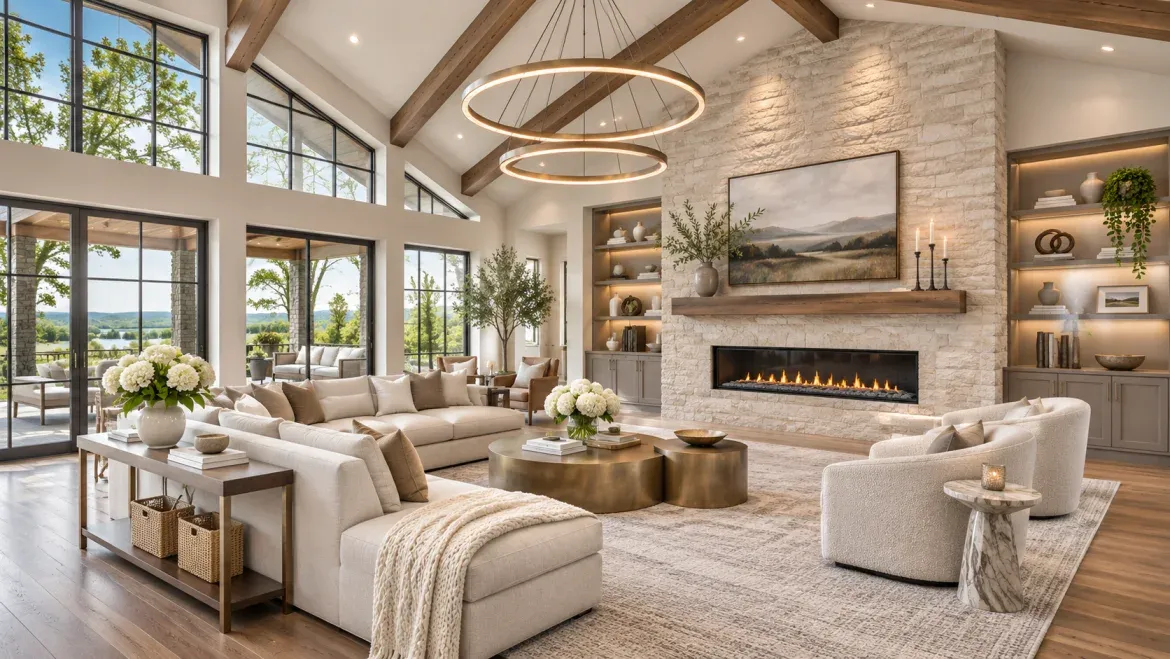
A room with a view has one job, and it is harder than it sounds: stay out of the way. This great room manages it. A wall of black-framed windows and glass doors opens onto a covered porch, the trees, and the water beyond, and everything inside is chosen to support that view rather than argue with it. The ceiling vaults up under exposed wood beams, a pale stone fireplace anchors the far wall, and the furniture sits low and quiet in cream, oatmeal, and brass.
It is a big room, but the ideas in it are small enough to borrow. Most of them come down to restraint.
Why the room works
The palette comes from outside. Nothing in the room is brighter than the view. The stone is the color of dry sand, the upholstery is cream, the wood is a soft honey brown, and the only real color is green: an olive tree by the doors, a trailing plant on the shelves, a few branches in a vase on the mantel. Because the room stays inside that narrow range, the eye travels straight through it to the trees and the lake.
The window frames do the outlining. Slim black frames turn each pane into a picture and give a pale room the one crisp line it needs. The black is not repeated much elsewhere, a pair of candlesticks on the mantel and the firebox itself, and that is why it reads as architecture rather than decoration.
There are two focal points, and they share. A room like this could easily become a contest between the fireplace and the view. Here the sectional settles it: one side faces the fire, the other runs along the windows, and the two swivel chairs across from it can turn toward either. The fireplace is long and low, set into the stone without a heavy surround, and the painting above it is a misty landscape in the same tones as the wall, so it echoes the view outside without competing with it.
The ceiling is brought down to earth. A vaulted ceiling can leave the furniture feeling stranded. The beams give the height some rhythm, and the two-ring chandelier hangs low enough to mark the center of the seating area, like a ceiling within the ceiling. At night it and the lit shelves take over from the windows.
Texture stands in for pattern. Rough-cut stone, nubby bouclé, a chunky knit throw, woven baskets under the console, a rug with a faint tone-on-tone weave, brushed brass on the coffee tables. There is almost no pattern anywhere, and the room does not miss it. When the colors are this close together, the differences in surface are what keep a room from looking flat, the same idea behind a fireside living room built on texture.
The palette
Stone, ivory, and greige sit close together and keep the room light. Oak and brass warm it from the ceiling down to the coffee tables. Green is the only accent, and it arrives through plants rather than paint or fabric, so the room changes a little with the season outside.
Approximate colors from the room image.
- Pale limestone#C9B29C
- The stacked-stone fireplace wall sets the warm, sandy base that every other neutral in the room is measured against.
- Soft ivory#D8C8B8
- The sectional and bouclé chairs sit a shade lighter than the stone, so the seating reads as soft rather than stark.
- Honey oak#8A6748
- Beams, mantel, and floor repeat one wood tone at three heights, which ties the tall room together from top to bottom.
- Aged brass#7A5C38
- The drum coffee tables and the chandelier rings add a low, warm sheen without introducing a new color.
- Warm greige#938479
- The built-in cabinets recede beside the stone and let the lit shelves above them do the displaying.
- Olive green#6B654A
- A tree, a trailing plant, and a few cut branches carry the color of the view into the room.
How to get the look at home
You do not need a vaulted ceiling or a lake. The same moves work on a living room with one good window.
- Decide what the room looks at. If there is a view, even a tree or a patch of garden, arrange the seating so at least one seat faces it, and keep that window clear of heavy curtains.
- Pull three colors from outside. Bark, stone, dry grass, leaves. Use the palest for the big pieces and the walls, the mid-tone for wood, and the green only in plants.
- Keep the furniture low near the glass. A sofa back, a console, or a chair that sits below the sill keeps the sightline open. Save height for the wall opposite the windows.
- Give the room one dark line. Black window frames are the built-in version. A black curtain rod, picture frames, or a slim metal lamp can do the same work.
- Layer texture before you add pattern. One nubby chair, one knit throw, one woven basket, one rough ceramic. Stop when every surface you can touch feels different from the one beside it.
- Hang one generous light over the seating. In a tall room, a wide fixture hung lower than you think is right makes the sitting area feel like its own room. Put it on a dimmer.
- Light the shelves and edit them. A few pots, a short stack of books, one plant, and plenty of empty space. Lit shelves give the room a warm glow after dark, when the windows turn black.
- Finish with something living. White hydrangeas on the coffee table and a tree in the corner do more for this room than any accessory. Cut branches from the yard work just as well.
A room like this is less about the things in it than about what was left out. If you are starting from scratch, begin with the feeling you want the room to have, then let the window make the rest of the decisions.
